
Finding Thankfulness After Trauma
A Gentle Practice for the Days After Thanksgiving
11/29/20252 min read

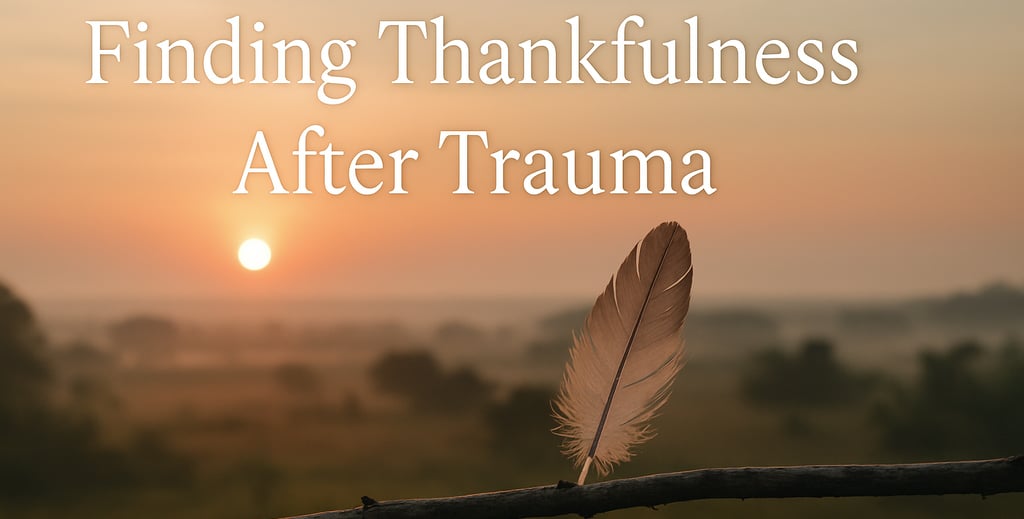
Thanksgiving often brings images of full tables, warm laughter, and families gathering with ease. But for many of us especially those carrying trauma this season can feel complicated. Gratitude doesn't always come wrapped in joy. Sometimes it arrives slowly, quietly, like a small feather drifting to the ground. Sometimes it feels far away.
And that’s okay.
Healing has never required perfection. It only asks for honesty, presence, and small steps forward. Today, in the calm after the holiday, we invite you to explore a softer, more compassionate view of thankfulness one that honors your journey and your nervous system, not just the expectations of a holiday.
Gratitude Isn’t About Ignoring Your Pain
Many trauma survivors struggle with gratitude because they’ve been told to “just be thankful” as a way of dismissing their experience. But true gratitude doesn’t silence your past. It doesn’t tell you to get over it. It doesn’t demand sunshine when the sky is still cloudy.
Real thankfulness says:
“I see everything you’ve survived and I’m grateful you’re still here.”
It recognizes your strength, not your ability to pretend.
Thankfulness After Trauma Is About Small, Present Moments
You don't need a perfect life to feel grateful. You don’t need a big, sweeping revelation. Often, healing starts with the smallest things your nervous system can handle:
The warmth of your morning coffee
The sound of waves or wind in the trees
The softness of moss under your feet
A breath that comes just a little easier today than it did yesterday
The quiet knowing that you are growing, even if no one sees it
Gratitude, for those healing from trauma, is not a performance.
It’s a practice of noticing.
Nature Shows Us How to Hold Both Pain and Thankfulness
The earth carries scars earthquake cracks, fire-touched soil, land rebuilt by lava and time. Still, the world continues to grow, regrow, and open. Just like you.
Nature teaches us that:
Broken places can become holy ground
Scars do not invalidate us they tell our story
Growth often happens in the cracks
Light finds its way in through the openings
When you step outside, even for a moment, you are reminded that healing is not linear. The earth doesn’t rush. Neither should you.
A Thankful Heart Doesn’t Need to Feel Full Just Honest
You don’t have to be thankful for everything that happened to you.
You don’t have to be thankful for the pain.
You don’t have to be thankful for the trauma.
But you might find thankfulness in the strength you gained.
In the ways you kept going.
In the resilience you didn’t know you had.
In the person you are becoming.
And if today you can’t find gratitude at all?
You’re still doing just fine.
Healing takes time.
And presence is enough.
A Simple Gratitude Practice for the Days After Thanksgiving
Take 3 slow breaths.
Look around your space or step outside.
Find one small thing that brings your body a sense of ease
not joy, not excitement, just ease.
This might be:
A patch of sky
A warm blanket
A steady heartbeat
A piece of earth beneath your feet
A soft feather you found on a walk
Hold that moment gently.
That is gratitude after trauma
not the loud celebration,
but the quiet survival.
You Are Allowed to Heal at Your Own Pace
This Thanksgiving, and every day after, may you honor your story, your strength, and the way your life continues to rebuild itself piece by piece, breath by breath.
Your healing is worth celebrating.
Your presence is worth being thankful for.
And you are not alone on this journey.